Today on Celebrate the Bible:
Listen now (4 minutes):
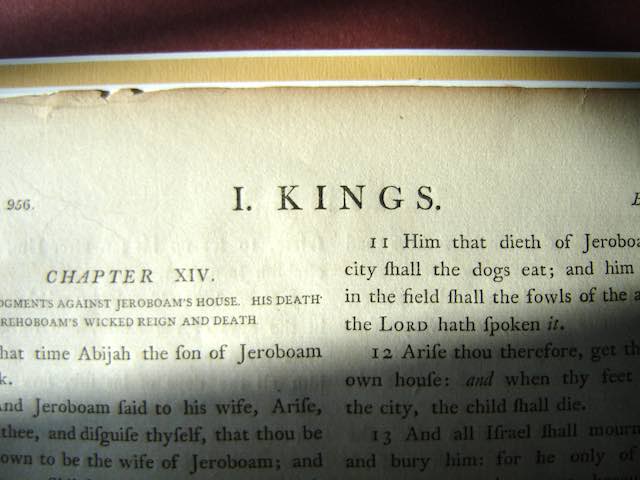
In 1798, John Thompson, a printer in Philadelphia, Pennsylvania, produced the first bible ever to be hot-pressed in America. This technique had earlier been practiced in England. It physically seared the ink onto and into the receiving paper.

Today, as we begin to approach the semiquincentennial year, the Thompson Hot-Press Bible, a printing of the authorized King James Version, remains somewhat of a rarity. Even a stray leaf is difficult to find and buy. As a complete bible, it is considered scarce. Thus, it remains a rare collectors item.
The title page reads: The Holy Bible, Containing The Old and New Testaments; Together with the Apocrypha; Translated out of the Original Tongues: And with the Former Translations, Diligently Compared and Reviled. John Thompson & Abraham Small
The size of this bible — a folio lectern bible — made it the largest ever printed in America up until that time
This Bible was sold by subscription. What this means is that, essentially, you would pay for the Bible in installments. You would get sections as their print runs would be completed. Subscribers to this Bible included Alexander Hamilton, Andrew Jackson, and Thomas Jefferson.
I should mention here that it wasn’t until 1782 that Robert Aitken printed the first English language bible in the relatively, new-founded United States of America. We’ll take a look at the Aitken Bible, including one printed by his daughter Jane, in future installments.
I’m including photos that show this beautifully printed bible. They are taken from the leaf that I have in my Celebrate the Bible collection. If you are listening to this as a podcast, and would like to see the photos, please go to celebratethebible250.com
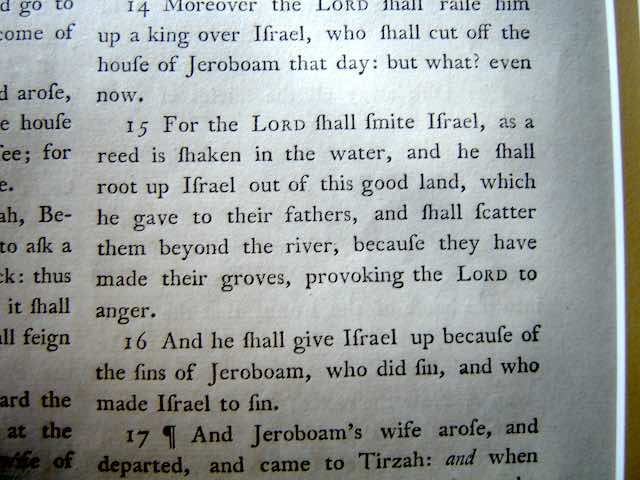
I am looking at the leaf. You are looking at the photos. The technical printing seems to remind me of the famous Baskerville bible. The type on the page looks sharp, much sharper than type usually found around this same time period. The differences one often distinguishes between analog and digital; or vacuum tube and solid state.
There is not a lot of historical information available about the Bible itself, nor about the printers Thompson or Small. I do have a copy of Isaiah Thomas’ The History of Printing in America. Still, consulting it provides no information on either of them. Yes, online resources surely exist.
Nevertheless, you, my dear readers and listeners, are just as capable of attending to that. You can do so if you’re interested further.
So, until we meet again, and for “Celebrate the Bible 250” this is Francis Douglas. If you’re interested in learning more about the History of the Christian Holy Bible in America, please subscribe now.
 America 250 Semiquincentennial Bible Celebration