Listen to Francis Douglas (6 minutes):
Today on Celebrate the Bible:
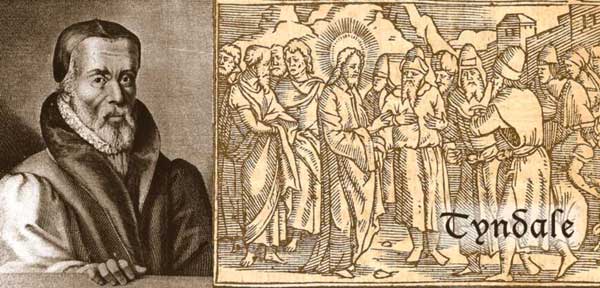
If you have a Bible that is written in English, you may be interested to know that one of the very first English translations was made by a man named William Tyndale.
Tyndale’s new testament dates back to the year 1526. It was republished many times, including the first American printing in the year 1837.
Today I am going to cover two versions: The 1837 American printing; and one from 1552 printed by Richard Jugge in London.
Both pieces are in my collection
Now, I will post photos. If you are listening to this as a podcast, please go to celebratethebible250.com.
Let’s Begin:
Many manuscripts eventually became the Holy Bible. The original languages for these manuscripts were Hebrew for the Old Testament, and the New Testament was mostly in Greek and included some Aramaic.
Every Bible version known today had to be translated from these original languages.
For the English language, the very first translation was made by John Wycliffe, in the late 1300s.
This was before the invention of the printing press. It had to be hand-written and copied. This was a lot of work to do! Needless to say, there are only a few copies still in existence of this early Bible.
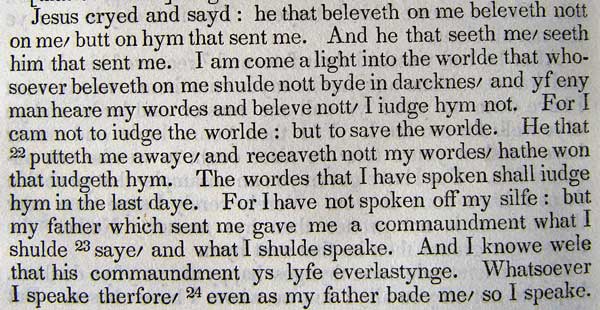
The English language used at the time of Wycliffe would not easily be understood today. By the 1500s, when William Tyndale arrived on the scene, the language had changed. It had become more modern.
Even today, 200 years makes a lot of difference in how people write and speak. This advancement in the English language occurred from the 1300s to the 1500s. It made Tyndale begin his own, more modern, English translation. He wanted the Holy Bible to be available to everyone. And so the Tyndale New Testament was born in the year 1526.
Unfortunately, it was against the law at the time for anyone to translate the Bible. This was especially true for translations into any language other than Latin. But Tyndale began on his own, regardless, going against the rules of the day. Besides that, he translated and interpreted areas of scripture differently than what had earlier been interpreted and translated.
There is a lot to learn about this era in Bible history, and you can learn about William Tyndale by accessing information online. Of course, not everyone agrees on every point being made. Sometimes it seems that there is an opposite opinion for every opinion in the world today!
Nonetheless, William Tyndale paid dearly for his Bible. He was strangled and burned at the stake in the year 1536. Many of his original Bibles were burned and destroyed. As a result, only three known copies of his original edition exist today.
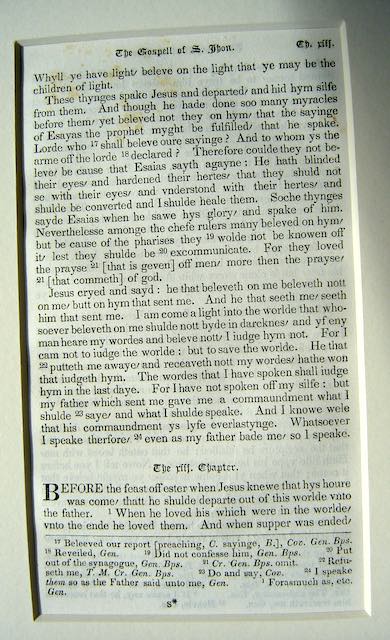
Printers continued to print the Tyndale Bible long after his death. And that leads us to my choice for today: the first American printing of the Tyndale new testament, of 1837. Gould & Newman published it in Andover, Massachusetts and New York.
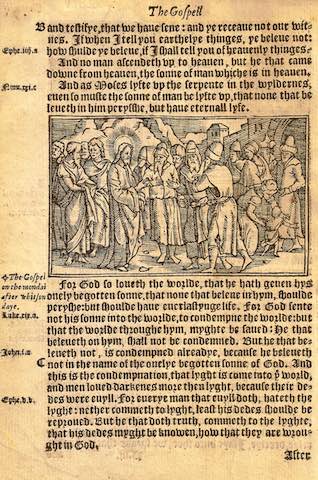
My collection also includes one of the very early Tyndale new testament pages. It is a very special one at that. It holds what was to become known in modern Bibles as John 3:16. Keep in mind that, back then, there were no verse numbers, just chapters.. The page was printed by Richard Jugge in London, in the year 1552.
To close out, I would like to read an excerpt for you now:
As follows, from an actual 1552 edition of Tyndale’s new testament:
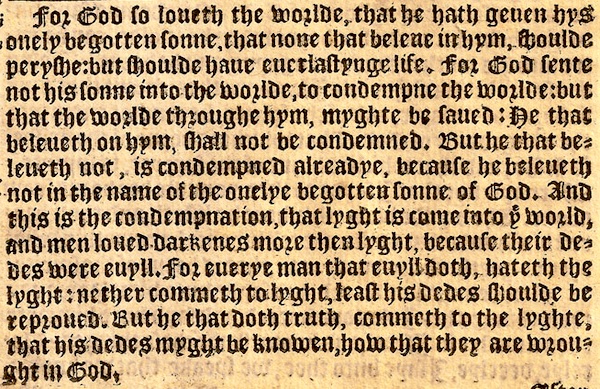
For God so loveth the world, that He hath given his only begotten Son, that none that believe in Him should perish: but should have everlasting life. For God sent not his Son into the world to condemn the world: But that the world through him, might be saved. He that believeth on him shall not be condemned. But he that believeth not, is condemned already, because he believeth not in the name of the only begotten Son of God. And this is the condemnation: that Light is come into the world, and men loved darkness more than light, because their deeds were evil. For every man that evil doeth, hateth the light: neither cometh to light, lest his deeds should be reproved. But he that doeth truth, cometh to the light, that his deeds might be known, how that they are right in God.
So, until we meet again, and for “Celebrate the Bible 250” this is Francis Douglas. If you’re interested in learning more about the History of the Christian Holy Bible in America, please subscribe now.
Addition Topics:
 America 250 Semiquincentennial Bible Celebration