Today on Celebrate the Bible:
The first bible printed in America for the Visually Impaired
LISTEN NOW (7 minutes):
If you are listening to this as a podcast, and you would like to view the photos, please visit celebratethebible250.com

Samuel Gridley Howe is known as the first director of the Perkins Institution for the Blind in Massachusetts. He was born in 1801. He graduated from Brown University in 1821 and Harvard Medical School in 1824.
Dr. John Fisher founded the New England Asylum for the Blind in 1829. He invited Samuel Howe to become the institution’s first director. The first students at the American school arrived in 1832, ranging in ages 6 to 21. Today, the Perkins School for the Blind is located in Watertown, Massachusetts.

Samuel Gridley Howe believed that blind students should not be “doomed to inequality” or regarded as “mere objects of pity.” Instead, he advocated for their education and traveled across 15 states to support schooling programs elsewhere in this country. In his first years as director, Howe helped found schools for the blind in Virginia, Ohio, Kentucky, and Tennessee.
In later years, Howe founded schools for children with intellectual disabilities in 1848 and deaf children in 1867. Howe opposed sign language as a method of communication. Instead, he preferred to teach lipreading and oral communication. Howe also developed an embossed letter system for the blind to read. This was first known as the Howe Type and later as the Boston Line Type. This reading format was used until Braille came into common use by the late 1800s.
According to the Perkins’ school web site, Valentin Haüy founded the world’s first school for the blind in 1786. This institution was established in Paris. He devised a printing system that could be read with the fingertips. Haüy used ordinary printing type. He cast it in reverse and pressed it against the back of the paper. This created embossed Roman letters.
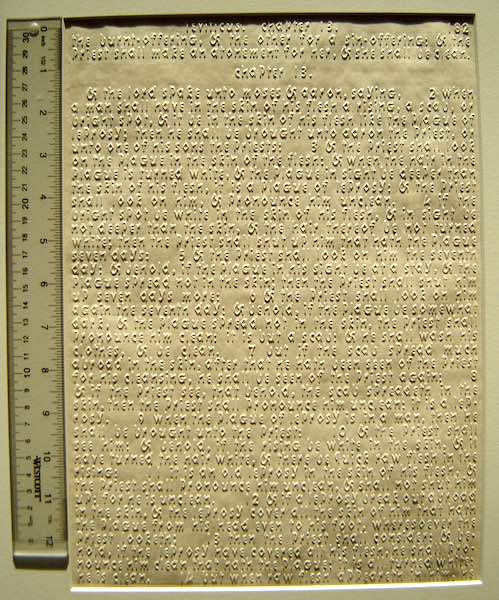
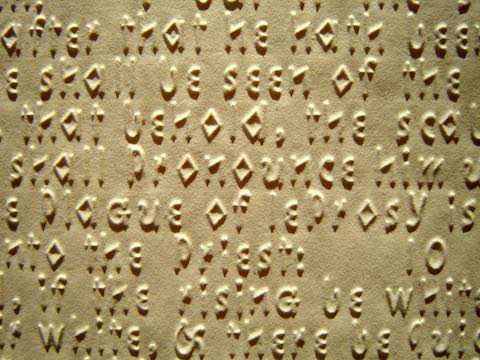
Samuel Howe developed an embossed alphabet called Boston Line Type in 1835. Because it was compact and had few confusing flourishes, he considered it vastly superior to the fonts used in Europe.
Howe commissioned a printer, Stephen Preston Ruggles, to design a press that could produce Boston Line Type books. Ruggles’ press produced books until 1881, when it was replaced with a more efficient design.
Since our example today was printed in 1842, it most likely was printed on Stephen Ruggles Boston Line Type press.

Ruggles went on to build printing presses for other institutions for the blind. These include the Overbrook School for the Blind in Philadelphia.
In 1843, Howe married Julia Ward, daughter of New York banker Samuel Ward and Julia Rush Cutler. Julia Ward Howe wrote the Civil War-inspired song, “Battle Hymn of the Republic.” Samuel and Julia had six children.
Samuel Gridley Howe passed away at the age of 74 in 1876 and is buried at Mt. Auburn Cemetery in Cambridge,
Massachusetts.
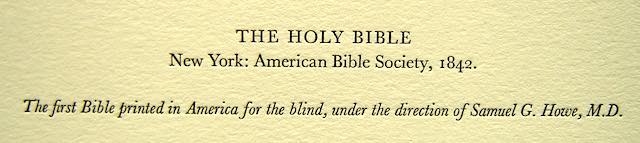
In closing, I would like to read a selection from my collection. It is from the first Bible printed in America for the Blind. This was under the direction of Samuel Gridley Howe, M.D., New York American Bible Society, 1842.
Taken from the book of Leviticus, Chapter 13.
As follows:
And the Lord spake unto Moses and Aaron, saying,
When a man shall have in the skin of his flesh a rising, a scab, or bright spot, and it be in the skin of his flesh like the plague of leprosy; then he shall be brought unto Aaron the priest, or unto one of his sons the priests:
And the priest shall look on the plague in the skin of the flesh: and when the hair in the plague is turned white, and the plague in sight be deeper than the skin of his flesh, it is a plague of leprosy: and the priest shall look on him, and pronounce him unclean.
If the bright spot be white in the skin of his flesh, and in sight be not deeper than the skin, and the hair thereof be not turned white; then the priest shall shut up him that hath the plague seven days:
And the priest shall look on him the seventh day: and, behold, if the plague in his sight be at a stay, and the plague spread not in the skin; then the priest shall shut him up seven days more:
And the priest shall look on him again the seventh day: and, behold, if the plague be somewhat dark, and the plague spread not in the skin, the priest shall pronounce him clean: it is but a scab: and he shall wash his clothes, and be clean.
So, until we meet again, and for Celebrate the Bible 250 this is Francis Douglas. If you’re interested in learning more about the History of the Christian Holy Bible in America, please subscribe now.



 America 250 Semiquincentennial Bible Celebration