Today on Celebrate the Bible:
LISTEN NOW (7 min):
The Christian Holy Bible played a significant role in schools and education. This influence dates back to the earliest days of settlements in North America. Until the 1960’s, school days usually started with a reading of Holy Scripture. They also included a recitation of the Lord’s Prayer.
For today’s selections, I have chosen several pieces of history from my collection. These pieces document, albeit in a very small way, what life was like living with the Bible “back in the day” (as the saying goes).
If you are listening to this as a podcast, and you would like to view the photos included with this episode, please visit celebratethebible250.com. Type school prayer into the search box, and the article should come up.
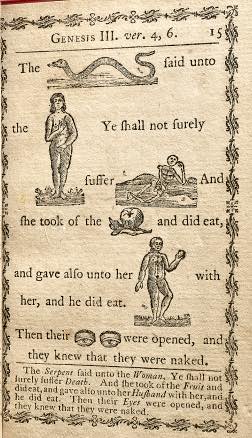
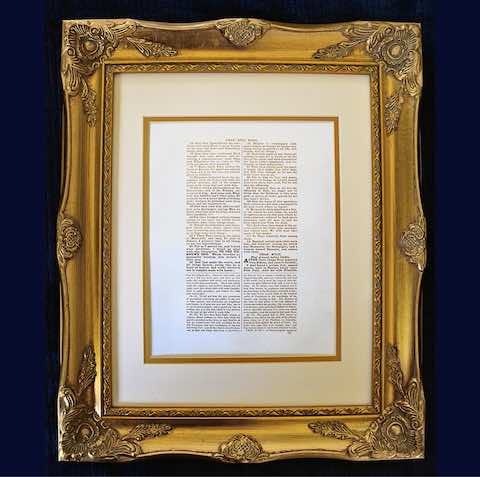
To start off, here is a piece from publisher and printer Isaiah Thomas titled: A Curious Hieroglyphic Bible. This is a children’s book from the year 1788. You notice that some of the words are replaced with pictures. I have a single leaf in my collection. There are only four remaining copies of the complete book. It is one of 88 books that were included in an exhibition, by the United States Library of Congress, titled “Books That Shaped America”.
To understand a “typical” start of the day in the lives of school children, I want to read an entry from the Supreme Court’s Abington School District v. Edward Schempp.
Now this is from the 1960’s, of course.
As follows:
“On each school day at the Abington Senior High School between 8:15 and
8:30 a.m., while the pupils are attending their home rooms or advisory
sections, opening exercises are conducted pursuant to the statute. The
exercises are broadcast into each room in the school building through an
intercommunications system and are conducted under the supervision of a
teacher by students attending the school’s radio and television workshop.
Selected students from this course gather each morning in the school’s
workshop studio for the exercises, which include readings by one of the
students of 10 verses of the Holy Bible, broadcast to each room in the
building. This is followed by the recitation of the Lord’s Prayer, likewise over
the intercommunications system, but also by the students in the various
classrooms, who are asked to stand and join in repeating the prayer in unison.
The exercises are closed with the flag salute, and such pertinent
announcements as are of interest to the students.”
There were many legal challenges to Bible reading in the classroom. However, it was the Supreme Court’s 1963 ruling in Abington School District v. Schempp that for the most part effectively ended school-sponsored Bible reading in the United States.
A few other items I wish to share with you include the following press photos that I have. I will also read the captions from each.
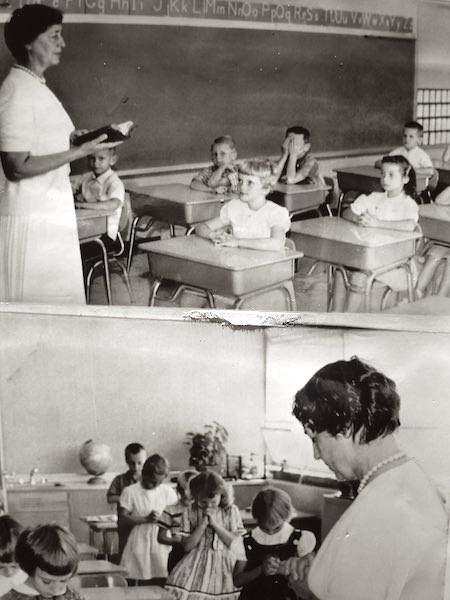
August 29, 1963. Mrs. Eleanor Engle reads the Bible to her second-grade pupils, top, and leads them in prayer, bottom, during first day of classes at Berlin Brothersvalley School near Somerset, Pa. The school district was one of five in Somerset County that voted to continue the daily devotional exercises despite the recent U.S. Supreme Court ruling.
And our next press photo:
March 25, 1969. Uniontown, PA. PRAYER READING RESUMED. Albert Gallatin School District in Fayette County has resumed prayer reading, despite a Supreme Court ruling. In classroom scene, Mrs. Jessie Clark reads from the Bible to her first-graders at D. Ferd Swaney Elementary School, six miles south of Uniontown. The action has brought favorable community response.

In my closing photograph, I would like to point out that outside-of-church Bible reading was not limited only to schools. It also flourished in the adult professional workplace. My final entry shows a Bible study class, in progress, at the Lockheed company in Marietta, GA. This press photo is from 1956.

In closing, let me propose two questions for my listeners and readers to ponder. First, will the Christian Holy Bible ever regain its past prominence in the lives of those in the United States? And (2) will our semiquincentennial 250th celebration be the catalyst for a 21st century Christian revival?
As the saying goes, only time will tell.
So, until we meet again, and for Celebrate the Bible 250 this is Francis Douglas. If you’re interested in learning more about the History of the Christian Holy Bible in America, please subscribe now.


 America 250 Semiquincentennial Bible Celebration