LISTEN NOW (7 min):
The late 1800’s to the early twentieth century marked significant advancements in the arts, sciences, and in communication technologies.
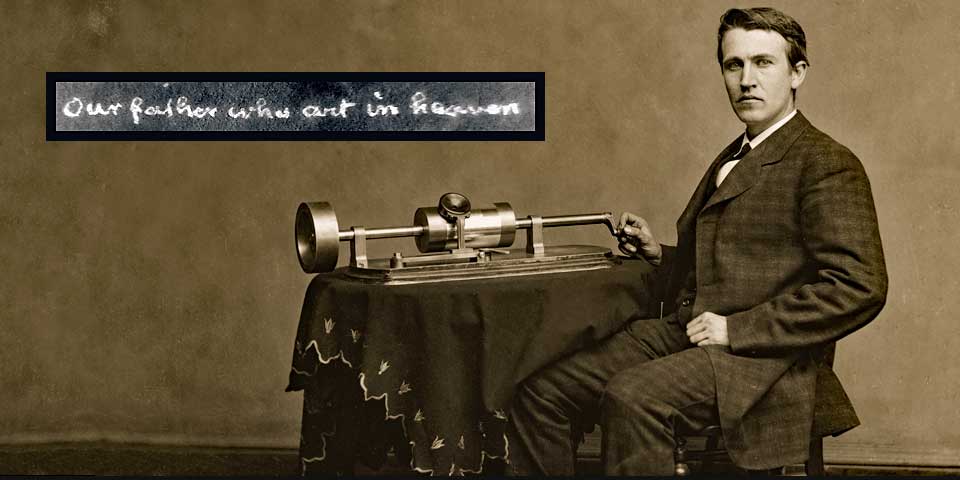
Like many of the great minds of that era, Thomas Edison was riding the crest of this revolutionary wave. One of the advancements was miniaturization — eventually leading to micro circuits and computer technologies.
One popular method of exhibiting miniaturization was the recording of the Lord’s Prayer.
For over 100 years, the Lord’s Prayer has been considered the reference standard. It has been practiced to demonstrate all advancements in miniaturization. Several methods were commonly used. These included micro script handwriting, microphotographs, etchings and engravings, micro printing, and those done by the famous pantograph machines.
Later in the 20th and 21st centuries, examples continued to emerge through vapor deposition and electron bombardment. The first nano scale Lord’s Prayer was recorded as a laser hologram.
Edison had many inventions to his credit. This includes over 1,000 patents. However, he did not invent the micro craze of the 1800s or early 1900s. That credit must go to a microscope manufacturer in Great Britain by the name of John Benjamin Dancer. Dancer was the inventor of many optical devices, including the first 3-D camera.
He also invented what was to become known as microphotography. Microphotography transformed what was life size into a smaller image. It reduced it down to a photograph with a diameter of a millimeter or so.
One of the very first microphotographs was of the Lord’s Prayer.
Thomas Edison is well known for his penmanship, practicing scripts, and inventing typographical fonts for the printing press. He ran a printing press in his youth.
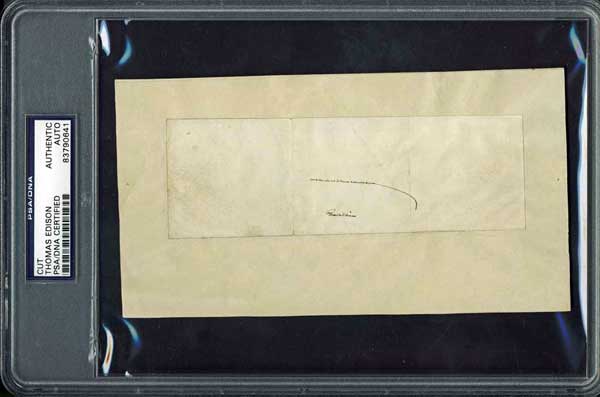
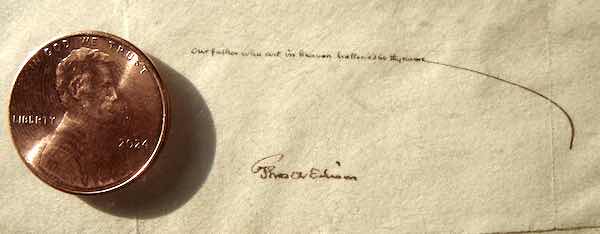
At first glance of his Lord’s Prayer writing sample, one sees a line of something. However, it is difficult to determine what that line is. Under a magnifying glass or microscope, it enlarges. It becomes an astonishing line of the tiniest handwriting. It reads, “our father who art in heaven hallowed be thy name.” It is signed underneath by Thomas Edison.

A representative from the auction house stated: “Some items come into the building and just stun us. This offering is one of those ultra-unique items. The motivation as to why Edison chose this quote to write is unknown. However, the fact that he writes something of this nature with religious overtures is interesting. Whatever the motivation was in creating this piece, it sure makes for a cool piece of memorabilia!”
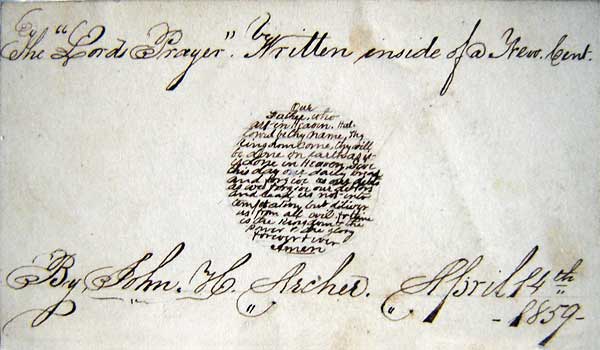
Let’s place Edison’s micro script Lord’s Prayer under magnifying optics. We can then examine the individual words of Thomas Edison’s line of micro-script. Keep in mind, when viewing the greatly magnified handwritten text here, never lose awareness of just how minuscule the writing actually is:
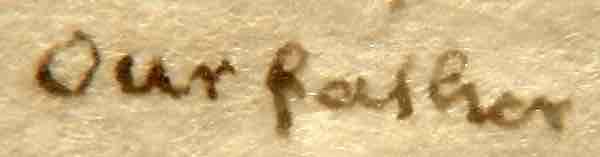
“our father“
Indicating that God is the Father of everyone, not just one individual or group of individuals. The use of “OUR” Father would include himself. The “Father of all” … OUR Father.
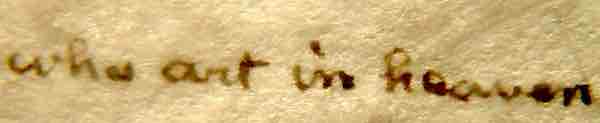
“who art in heaven“
Edison has stated that he did not believe in an afterlife, although he did believe in a higher intelligence. This phrase indicates where he believes his Father resides: in heaven. The word “who” originates from the Anglican Book of Common Prayer. It is used instead of the more common “which”. It was later included in the Douay-Rheims 1899 American Edition.
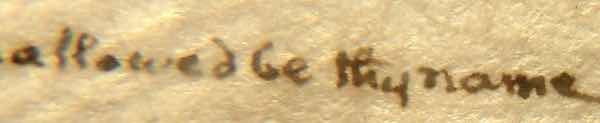
“hallowed be thy name“
Merriam-Webster puts it this way: Definition of Hallowed: Holy, Consecrated; the church stands on hallowed ground. Hallowed is the past participle of the verb hallow, a term that descends from the Middle English halowen. That word can in turn be traced back to hālig, Old English for “holy.” The “Hallowed be thy Name” phrase is the first of the seven petitions in the prayer.

“Thos a Edison”
Now, keep in mind, that Thomas Edison not only wrote the opening to the Lord’s Prayer, but did what many others before him did not do. He signed his name to it in his own hand. It is well known that Edison was very particular about his signature, and intentionally redesigned it several times throughout different times of his life. In this case of Thomas Edison, it may very well be the smallest hand-written signature / autograph in the world.
To create the Lord’s Prayer, it is said that he used a thin paintbrush … with all of the bristles removed except for one lone bristle.
In closing, let me challenge parents and teachers to give it a try with their children and students. Show them the beautiful example from Thomas Edison. Using only their own talents and methods, let them create their very own world’s smallest handwritten Lord’s Prayer!
Oh, and another thing: if you ever want to see Thomas Edison’s personal Bible, with his name embossed in gold, you can find it displayed prominently at his home in East Orange, New Jersey. It appears to be a very well-read Bible.
So, until we meet again, and for Celebrate the Bible 250 this is Francis Douglas. If you’re interested in learning more about the History of the Christian Holy Bible in America, please subscribe now:

 America 250 Semiquincentennial Bible Celebration