
LISTEN NOW (6 minutes):
PODCAST TRANSCRIPT:
Today on Celebrate the Bible, we’ll explore the first Bible printed in America: The John Eliot Indian Bible.
It was also the first Bible printed outside of Europe, and the first Bible translated into an indigenous American language.
It was printed for the Algonquin Indians of New England.
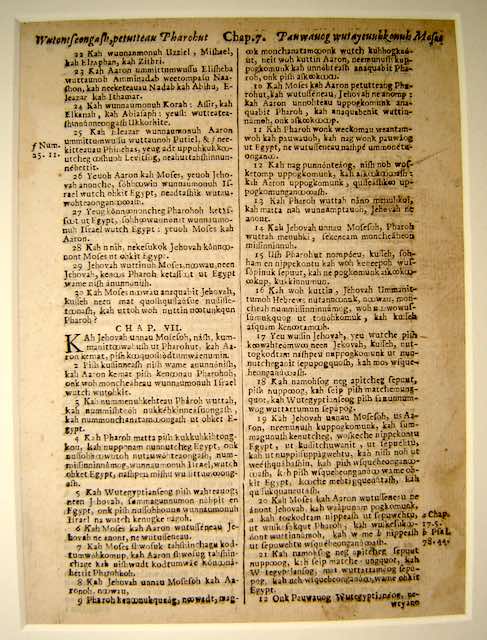
John Eliot was a Cambridge-educated clergyman. He learned the Massachusett Natick dialect with help from a young Indian member. Many modern scholars, however, claim that he had a team of interpreters.
He then set up church services for the Algonquin.
According to one of John Eliot’s biographers his outlook was “I made my interpreter and thus I came at it. We must not sit still and look for miracles. Up and be doing, and the Lord will be with thee.”
Providing them with their own Bible was his next step. He worked on this Bible for over 14 years, and relied on the Geneva Bible for the translation.
The project was supported by private donations by a Protestant missionary group in England and Wales. They referred to themselves as the Society for the Propagation of the Gospel in New England.
The Society was headed by the eminent scientist Robert Boyle. He was one of the founders of modern chemistry. Boyle was also the founder and fellow of the Royal Society. He is considered one of the pioneers of modern experimental scientific method.
He was a staunch defender of Christianity.
The Eliot Algonquin Bible was funded completely overseas. There were no donations or money from the New England colonies themselves.
The difficult task of translation was compounded by the fact that the Algonquins had no history of written language. Eliot had to first master the spoken language. Then, he began to create a written form of it … for reading.
Eliot completed the New Testament in 1661; and by 1663 he had translated the entire Christian Bible. He had them printed in Cambridge, in the Massachusetts Bay Colony, by printers Samuel Green and Marmaduke Johnson.
It contained 1,180 pages. Each page contained an average of over 4,000 type characters.
It is said that approximately 1,500 Eliot Bibles were printed of the 1663 first edition. Still, I believe there are less than 40 remaining copies throughout the entire world.
At one time, the language was considered extinct. By 1800 only one speaker of the dialect remained. For many years, the Eliot Indian Bible was considered “The Bible that No Man can Read”. But, with the recent advent of language reclamation projects, many formerly extinct languages have been returning throughout the world.
After completion, he wrote: “Prayers and pain through faith in Christ Jesus will do
anything.”
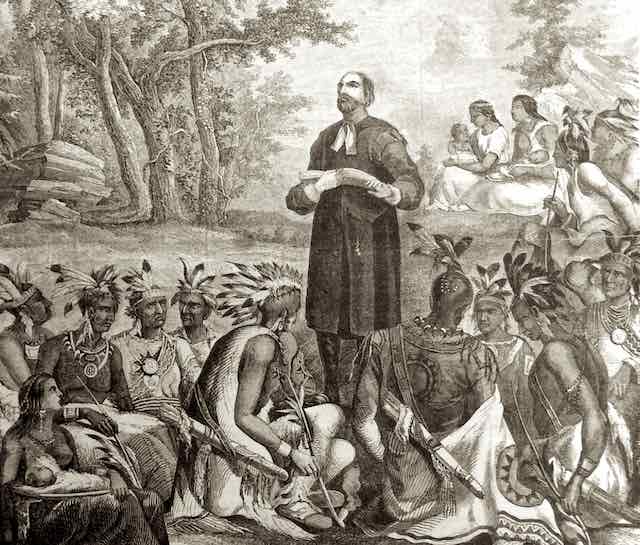
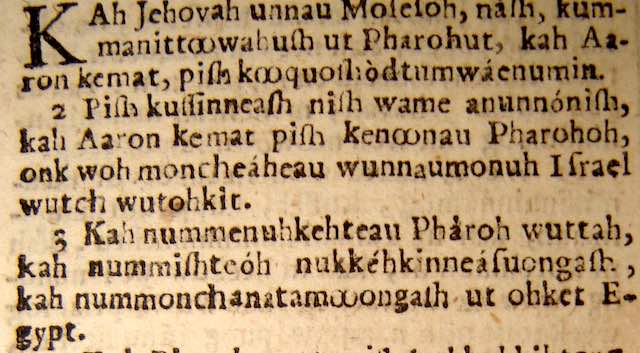
Fortunately, we do know what books, chapters, and verses are within the Eliot Bible. I would like to read and show a passage, taken directly from the Eliot Bible leaf in my own collection. I will show a side-by-side comparison of both English and Algonquin.
You’ll be able to see from the photo that this reading is referencing Exodus, Chapter 7, verses 1 through 6.
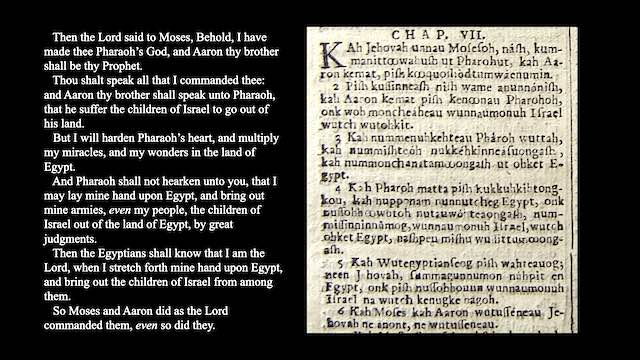
If you are listening to this as a podcast, please go to celebratethebible250.com. You can view the photos included with this episode. Just type “Indian Bible” into the search box, and the page will be returned to you as a link.
As follows:
Then the Lord said to Moses, Behold, I have made thee Pharaoh’s God, and Aaron thy brother shall be thy Prophet.
Thou shalt speak all that I commanded thee: and Aaron thy brother shall speak unto Pharaoh, that he suffer the children of Israel to go out of his land.
But I will harden Pharaoh’s heart, and multiply my miracles, and my wonders in the land of
Egypt.
And Pharaoh shall not hearken unto you, that I may lay mine hand upon Egypt, and bring out mine armies, even my people, the children of Israel out of the land of Egypt, by great judgments.
Then the Egyptians shall know that I am the Lord, when I stretch forth mine hand upon Egypt, and bring out the children of Israel from among them.
So Moses and Aaron did as the Lord commanded them, even so did they.
So, until we meet again, and for celebratethebible250, this is Francis Douglas.
If you would like me to give a presentation and small exhibit to your church group, school, or organization, on the History of the Christian Holy Bible in America, I’ll place contact information below as the 2026 Semiquincentennial year approache
I will be available for Southern New Jersey, Southeastern Pennsylvania, and Northern Delaware.

 America 250 Semiquincentennial Bible Celebration