LISTEN NOW (6 minutes):
PODCAST TRANSCRIPT:
Today on Celebrate the Bible, we’ll examine one of the finest examples of American Printing of the Holy Bible. That Bible being the Bruce Rogers World Bible.
This Bible is credited by many book designers and art directors as one of the three most beautifully produced typographical Bibles in the world. The other two are The Doves Press Bible and the Baskerville Bible, both from Great Britain.
If you are listening to this as a podcast, and would like to view the photos associated with this episode, please go to celebratethebible250.com and type “world bible” into the search box.

The World Bible was published in 1949 by the World Publishing Company. It was designed by Bruce Rogers. He previously designed the Oxford Lectern Bible.
Rogers was the first typographer to receive the Gold Medal from the American Academy of Arts and Letters.
I’ll have links to more biographical information on Bruce Rogers below.
TWO YEARS IN DESIGN AND PRODUCTION
His selection of typeface was one of Frederic Goudy’s lesser-used but most beautiful creations, the face he called Newstyle. It was slightly modified by Rogers and reissued as Goudy Bible.
The paper chosen was a seventy-five percent linen rag content, off-white. It was chosen due to its ease of reading under artificial light.

The time required for typesetting, page layout, proof reading and correcting was two years.
Finally, in October of 1949, from typesetting through press work, the job was completed. The finished folio Bible weighed over twenty-four pounds, and contained 968 pages.
It was printed in an edition of nearly 1,000 copies, and was priced at $200 per Bible (which would be exactly $2,726.14 in the year 2025).
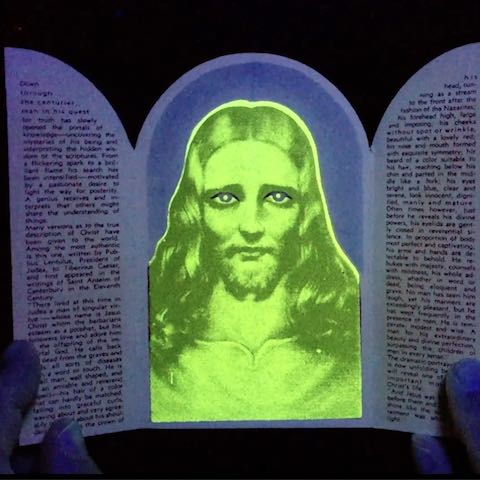
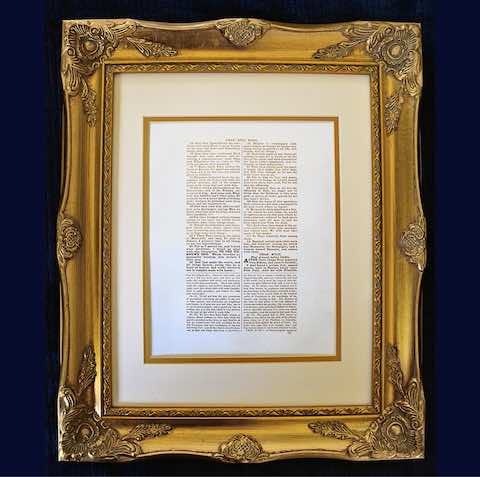
The company sent a prospectus to potential customers in August of 1948. I am fortunate to have a copy of that prospectus in my Celebrate the Bible collection. It contains several full-sized pages from early press-runs. One of those pages is the title page from Genesis. This page is the most sought-after of any Bible pages for collectors.
It also contains an announcement page written by Bruce Rogers himself. I would like to read a few excerpts from what he wrote.
As follows in his own words:
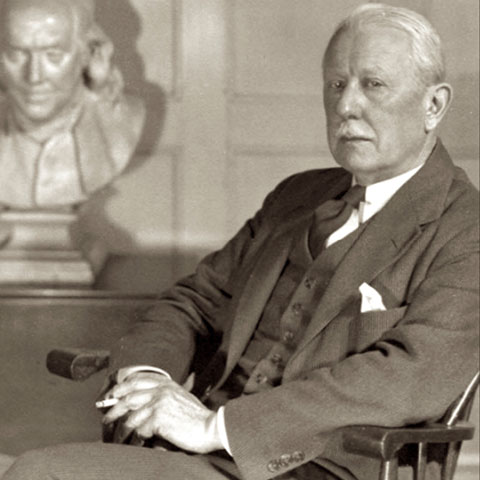
BRUCE ROGERS IN HIS OWN WORDS
Zeal to promote the common good, whether it be by devising anything ourselves, or revising that which has been laboured by others, deserveth certainly much respect and esteem, but yet findeth cold intertainment in the world. Thus began the translators of the King James Bible, and their introduction seems particularly apropos here.
The project of making a folio Bible is not one to be undertaken lightly at any time. In these days of unsettled conditions and high costs of production, it might almost be called reckless. Nevertheless, Mr. B.D. Zevin of The World Publishing Company commissioned me three years ago to design such a folio for his firm. With this appreciation of fine printing, and as one of America’s foremost Bible publishers, Mr. Zevin has felt keenly the lack of a contemporary American Bible in the great tradition.
The type is the first use of a face called Goudy Bible. It is a version of Frederic Goudy’s Newstyle, which I considered for the Oxford Bible, but which was not practical to use in England at that time. Three years ago, however, with Mr. Goudy’s cordial permission, the face as he cast it was slightly modified under my direction for Monotype composition, and a new set of 18-point matrices were made for The World Publishing Company, and delivered to the printer, Mr. A Colish of New York.

PRODUCTION SPECIFICATIONS
In closing, for those who have an interest, here are the specifications of the Roger’s World Bible, as taken directly from the prospectus: It is a folio of about 1000 pages, 13-1/4 x 18-1/2 inches. There are 975 numbered copies. The 18-point Goudy Bible type is set in double columns, the prose text solid, and the metrical portions in verse. The stock is a high-content rag paper, specially made for this book by the Worthy Paper Company. The binding is of stout boards, covered with a heavy maroon buckram, stamped on both covers, showing various Biblical emblems.
And that’s about all I have for today’s episode.
So, until we meet again, and for celebratethebible250, this is Francis Douglas.
If you would like me to give a presentation, at your church, school, gallery, or organization, let me know. I will also provide tabletop displays.
The topic I cover is the History of the Christian Holy Bible in America.
Not only will your group learn about it, but they’ll also see — on display — pages from the most significant Bibles in American history.
See my contact information below to inquire.
I will be available for Southern New Jersey, Southeastern Pennsylvania, and Northern Delaware.
*Additional information for this episode (other than from the prospectus) has been obtained from the Purdue Alumnus, Volume XXXVII, Number 7, 1 April 1950.
ADDITIONAL RESOURCES:
Bruce Rogers Typographer (at WikiPedia)
Library of Congress: Bruce Rogers Special Collections
CONTACT (for presentation inquiries only please):
Available for Southern New Jersey, Southeastern Pennsylvania, and Northern Delaware.




 America 250 Semiquincentennial Bible Celebration