LISTEN NOW (6 minutes):
PODCAST TRANSCRIPT:
Today on Celebrate the Bible, we’ll take a look at the history of “In God We Trust.” We will explore how it came to be minted on our coins.
If you are listening to this as a podcast, please go to celebratethebible250.com to see the photos associated with this episode. If it’s no longer on the front page, simply type “In God We Trust” into the search box. You can find the search box at the bottom of the page.
In 1792, Congress passed its first law concerning national coinage. This law established the U.S. Mint . It stipulated that the coins struck there should have “proper devices and inscriptions”, and section 10 of this law laid out the actual inscriptions that were to be on the coins:
“Upon one side of each of the said coins there shall be an impression emblematic of liberty, with an inscription of the word Liberty and the year of coinage; and upon the reverse of each of the gold and silver coins there shall be the figure … of an eagle with this inscription ‘United States of America’. And upon the reverse of each of the copper coins, there shall be an inscription which shall express the denomination of the piece”
In 1837, Congress passed another law, amending the 1792 law. The 1837 law made extra changes to the inscriptions for the coins. Gold and silver coins would still have the word “Liberty” and the year on one side. An eagle with United States of America would be on the other side.
Copper coins were to include the word “Liberty.” This would also show the year, the value of the coin, and United States. But, the representation of an eagle would be omitted.
During the Civil War years, the Secretary of the Treasury received petitions. These petitions requested that a motto mentioning God be included on coins minted in the United States.
According to the Treasury Department’s website, a Pennsylvania minister named Mark Watkinson made the first request in November of 1861. He suggested that the motto state “God, Liberty and Law.” This is also detailed in “In God We Trust,” a book by William Bierly.
Secretary of the Treasury Salmon P. Chase directed James Pollack at the U.S. Mint to prepare a device which would show “the trust of our people in God.” He wrote the following to Pollack:
“No nation can be strong except in the strength of God, or safe except in His defense. The trust of our people in God should be declared on our national coins. You will cause a device to be prepared without unnecessary delay with a motto expressing in the fewest and tersest words possible this national recognition.”
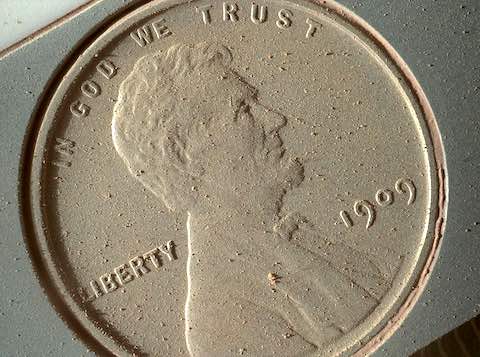
Congress had already passed the laws on coin designs. So, Congress would have to pass extra legislation before any changes could be made.
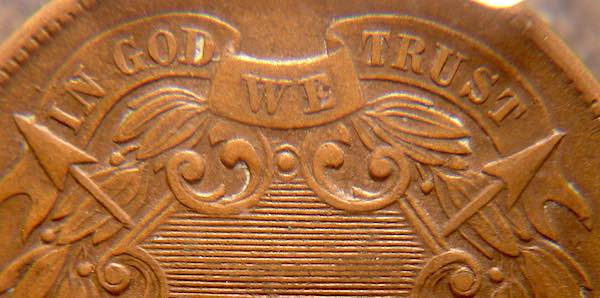
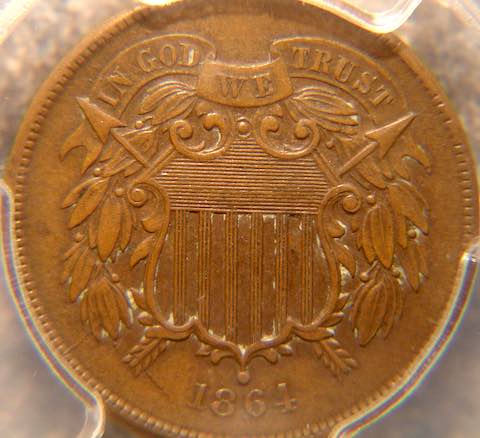
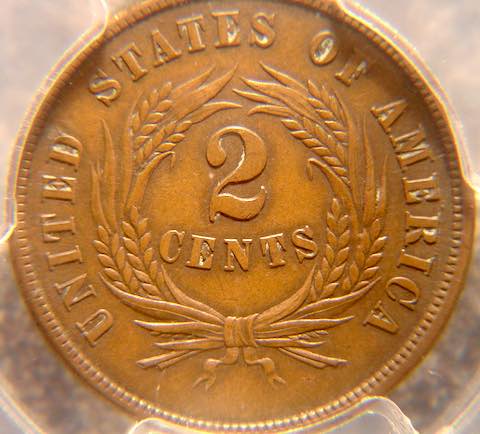
In the year 1864, the United States Mint issued two cent coins with the motto “In God We Trust.”
On July 30, 1956, Congress passed House Joint Resolution 396. The resolution contains 16 words. It states, “The national motto of the United States is hereby declared to be ‘In God we trust.”
Next, I have a sample of paper currency:
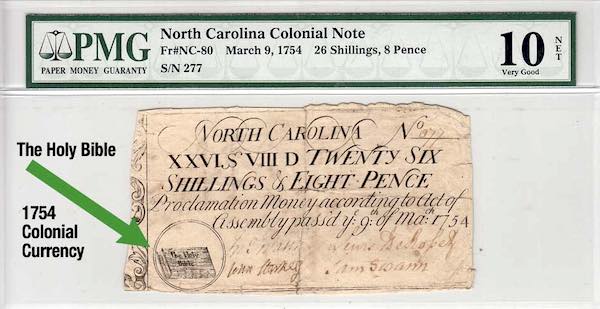
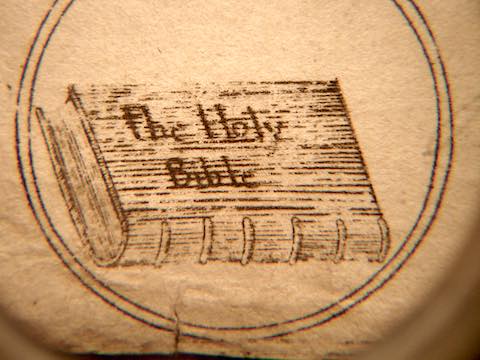
This bill is one of 4,000 pieces of paper currency released on March 9, 1754. It was authorized by the colony of North Carolina. The bill includes the image of the Holy Bible in the form of what appears to be a woodcut. It is estimated that less than 500 of these bills survive today.
I brought this bill to one of my presentations. I was pleasantly surprised at how fascinated the attendees were to see it. I also had Biblical-based coins as well.
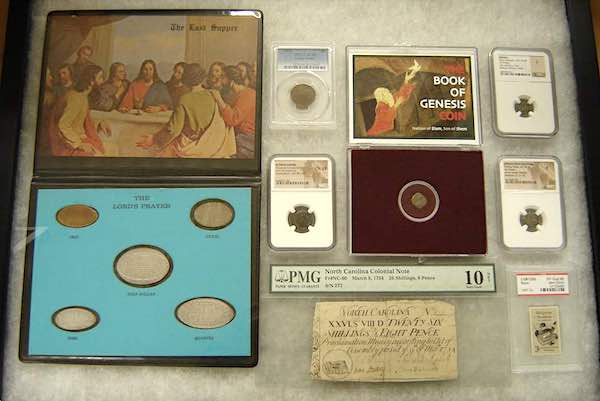
And, in closing, here’s a quick snapshot of my humble Bible related coin collection … which has grown significantly since this photo had been taken. This collection includes coins from the era of Pontius Pilate and Constantine. It also includes a Widow’s Mite, and the first US coin to have “In God We Trust” minted on it.
It also shows pre-revolutionary paper currency with a Bible printed on it. One of my favorites is a complete set of Lord’s Prayer coins. These are the kind that you put into a machine, which flattens your coin and mints something on it. These machines are still around, and you’re most likely to find them at tourist sites. But you’re not likely to find one that stamps the Lord’s Prayer any longer. This is a complete set containing a penny, nickel, dime, quarter, and half-dollar.
So, until we meet again, and for celebratethebible250, this is Francis Douglas.
If you would like me to give a presentation at your church, school, gallery, or organization, please let me know. My contact information is below.
The topic I cover is the History of the Christian Holy Bible in America.
Your group will not only learn about it. They will also see, on display, pages from the most significant Bibles in American history.
I will be available for Southern New Jersey, Southeastern Pennsylvania, and Northern Delaware.
CONTACT (for presentation inquiries only please):
Available for Southern New Jersey, Southeastern Pennsylvania, and Northern Delaware.



 America 250 Semiquincentennial Bible Celebration