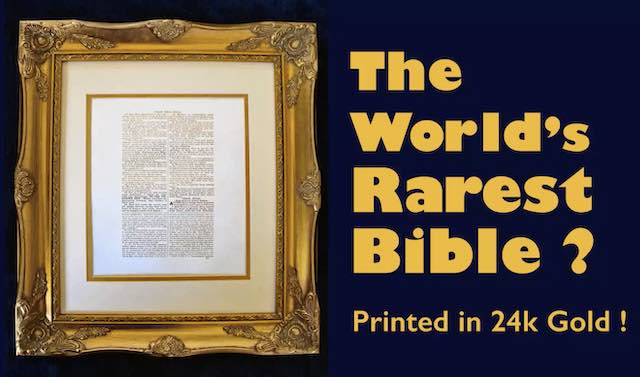
The De La Rue New Testament, printed in London between 1829-1831, is among the rarest Bibles, with only 25 copies made using 24k gold ink. Unlike the Gutenberg Bible, which has 49 surviving copies, the De La Rue Bible’s purity and print method contribute to its uniqueness, weighing 5 kilograms in total.
LISTEN NOW:
PODCAST TRANSCRIPT:
Some say that the famous Gutenberg Bible is the rarest Bible in the world. But is that statement true? Today we’ll look at a Bible that will make you say “not so fast”.
My name is Francis Douglas, and welcome to Celebrate the Bible.
Type “What is the rarest Bible in the world?” into any search engine, and notice how many returns come back referencing the Gutenberg Bible. While it is true that there are only 49 copies of the Gutenberg that have survived until today, the original printing was for 180 copies.
Of the 49 that still exist, they are — for the most part — in library, university and museum collections. Keep in mind that less than half of the 49 copies are complete, with many consisting of just a few scattered pages.
Now lets take a look at our Celebrate the Bible selection for today: Referred to as the De La Rue New Testament, printed in London, between 1829-1831, and with a print run of only 25 copies, it is truly one of the rarest Bibles in the world … yesterday OR today. Add the fact that this Bible was printed in pure gold, and you have one of the most unique Bibles in the world today as well!
It is known as a “typographical wonder”, and a single copy of one of the 25 printed was presented to was presented to King William IV in 1831.
Thomas De La Rue developed a method of printing which used 24 karat solid gold ink. Why 24k, and not 14k or 18k? Well, as any gold collector will tell you, due to its purity, 24k gold does not tarnish.
24k gold is 99.9%, or even better 99.999%, pure gold. There remains pure gold from thousands of years ago that looks exactly the same as it did back then. Truly amazing.
Here’s an interesting additional bit of information: Due to the 24k gold ink, each page weighs an astonishing 2.2 grams. AND, the entire book weighs in at 5 kilograms, or 11 pounds!
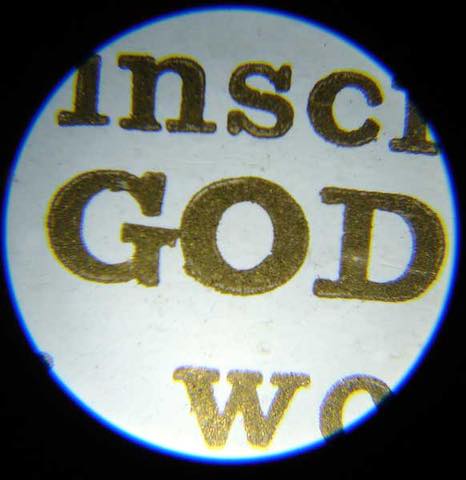
I do not know if the De La Rue Bible has other metals mixed in with the 24k gold flakes or not, so I put it under a microscope and took a few photos. I would have to refer to someone who is more familiar with the examination of gold to determine if other metals are present in the mix or not. Look for the photomicrographs of this amazing Bible at my WordPress web page at celebratethebible.com
The ultimate result of this new technology was the Bible that you are looking at here at the Celebrate the Bible: the De La Rue New Testament.
Previously, 24k gold was used for gold initial capital letters, and other illumination flourishes, within both manuscripts and bibles. Most added by hand.
Many manuscript pages are sold as works of art due to these fanciful additions.
With the de la rue New Testament, the gold lettering is printed on a modified printing press, NOT painted as with a brush by hand.
Let’s move on to the content of the Page:
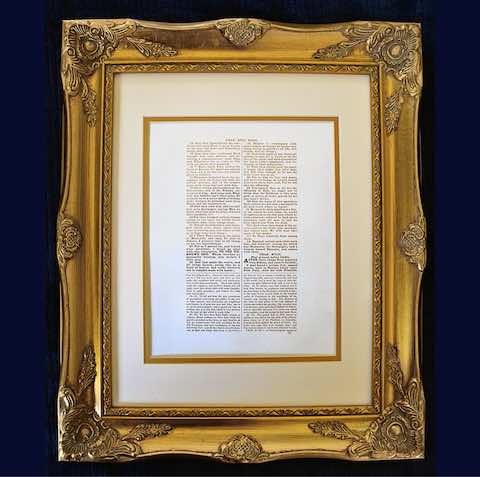
The scripture section that is on the Bible page that I now have is from the Book of ACTS chapter 17 verse 14 through chapter 18 verse 26. This contains the famous reference and story of Paul at Mars Hill, or the aereopogus, and also the Greek altar of their Unknown God.
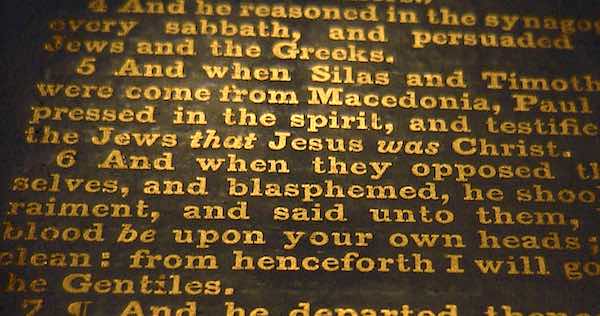
I would like to take a moment to read a selection from the De La Rue Gold New Testament:
As follows:
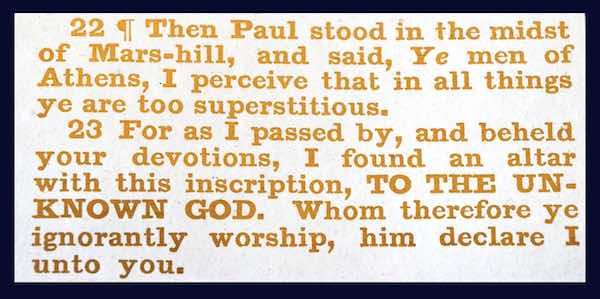
Then Paul stood in the midst of Mars’ hill, and said, Ye men of Athens, I perceive that in all things ye are too superstitious.
For as I passed by, and beheld your devotions, I found an altar with this inscription, To The Unknown God. Whom therefore ye ignorantly worship, him declare I unto you.
God that made the world and all things therein, seeing that he is Lord of heaven and earth, dwelleth not in temples made with hands;
Neither is worshipped with men’s hands, as though he needed any thing, seeing he giveth to all life, and breath, and all things;
And hath made of one blood all nations of men for to dwell on all the face of the earth, and hath determined the times before appointed, and the bounds of their habitation.
That they should seek the Lord, if haply they might feel after him, and find him, though he be not far from every one of us:
For in him we live, and move, and have our being; as certain also of your own poets have said, For we are also his offspring.
Forasmuch then as we are the offspring of God, we ought not to think that the Godhead is like unto gold, or silver, or stone, graven by art and man’s device.
And the times of this ignorance God winked at; but now commandeth all men every where to repent:
Because he hath appointed a day, in the which he will judge the world in righteousness by that man whom he hath ordained; whereof he hath given assurance unto all men, in that he hath raised him from the dead.
And when they heard of the resurrection of the dead, some mocked: and others said, We will hear thee again of this matter.
So Paul departed from among them.
Many of my listeners will notice in the photos that the Bible page appears to be split into an upper section and a lower section. That is because the upper section contains the Biblical Scripture reading, and the lower section contains commentary from the famous Matthew Henry commentary series.
Matthew Henry was born in 1662 and died in 1714. His life-long reputation rests almost entirely on his commentary. Charles Spurgeon once said that “Every minister ought to read it entirely and carefully through once at least.”
Henry lived only long enough to finish his commentary up until the book of Acts, which is the book that the page in the collection is from.
I would like to read a few short random selections of Matthew Henry’s commentary concerning the content of the page in the collection, and particularly the previous scripture which I have read earlier. It is of interest to me because Paul is referring to God as Creator of the universe. As follows from a 1721 edition of Matthew Henry’s commentary in my collection:
- He is the God that made the world, and all things therein the Father almighty, the Creator of heaven and earth. This was admitted by many of the philosophers but those of Aristotle’s school denied it, and maintained “that the world was from eternity, and every thing always was from eternity, and every thing always was what now it is.” Those of the school of Epicurus fancied “that the world was made by a fortuitous concourse of atoms, which, having been in perpetual motion, at length accidently jumped into this frame.” Against both these Paul here maintains that God by the operations of an infinite power, according to the contrivance of an infinite wisdom, in the beginning of time made the world and all things therein, the origin of which was owing, not as they fancied, to an eternal matter, but to an eternal mind.
- He is therefore Lord of heaven and earth, that is, he is the rightful owner, proprietor, and possessor, of all the beings, powers, and riches of the upper and lower world: material and immaterial, visible and invisible. This follows from his making heaven and earth. If he created all, without doubt he has the disposing of all: and, where he gives being, he has an indisputable right to give law.
So, until we meet again, and for celebratethebible.com, this is Francis Douglas.
If you would like me to give a presentation at your church, school, gallery, or organization, please let me know. My contact information is below.
Contact Francis Douglas: fd316@celebratethebible250.com
The topic I cover is the History of the Christian Holy Bible in America.
Your group will not only learn about it. They will also see, on display, pages from the most significant Bibles in American history.
I will be available for Southern New Jersey, Southeastern Pennsylvania, and Northern Delaware.



 America 250 Semiquincentennial Bible Celebration