LISTEN NOW (podcast 9 min):
PODCAST TRANSCRIPT:
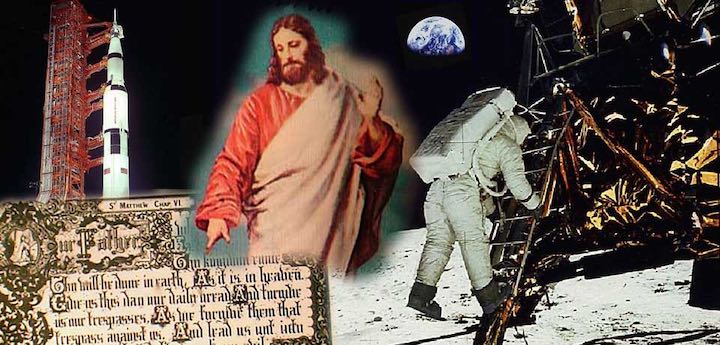
It took a lot of science and technology to put an astronaut on the surface of the moon. But, as you’ll see, the real credit for getting there should be given to the Lord’s Prayer…
My name is Frank Douglas, and I would like to welcome you to Celebrate the Bible.
The Lord’s Prayer has been used as a reference standard to show scientific and technological advancements in miniaturization for over 150 years.
On today’s program, I would like to show how micro Biblical scripture — and the Lord’s Prayer in particular — eventually led the way to satellites, space exploration, and landing the first human on the moon.
Just how did this happen? I’m glad you asked:
Microphotography from the 19th century eventually led to 20th century micro data storage media such as microfilm. This, in turn, led to micro photo-lithography of computer memory chips and circuitry. The computer chips and circuits that you are using right at this very moment … here in the 21st century.
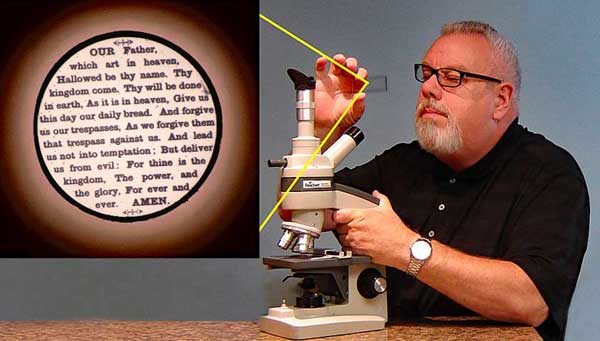
(above photo): Microphotographs are so small that they cannot be seen with the unaided human eye. Before magnification, they are the size of an average snowflake. Here I am examining one before placing it into my microscope to view.
The early computer circuits that placed the first man on the moon were the direct descendants of microphotography of the 1800s: the same microphotography that brought us the famous Lord’s Prayer.
It is the great, great, great, grandfather of everything that is performed with micro and nano scale technologies in today’s world.
In other words: the computers that put man on the moon began with microphotography … and microphotography began with Biblical Scripture.
There have been many Christian related events associated with the moon landings of the NASA Apollo program.
First, we have the famous reading of the Biblical account of Creation in Genesis, taking place as Apollo 8 broadcast from orbiting the moon on Christmas Eve 1968. We didn’t land on the moon during that trip, but it was the furthest we’ve ever been from Earth. The astronauts orbited the moon ten times.
On July 20, 1969, with Apollo 11, we landed the first humans on the moon. Right after landing, the first Holy Communion was performed by astronaut Buzz Aldrin, while he was still in the cabin of the lunar lander.
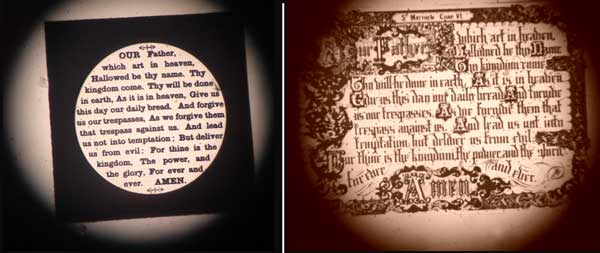
(above photo): PLAIN and FANCY… Two examples of nineteenth century microscopic Lord’s Prayers as seen through microscopes. Note the extraordinary beauty and detail (right image) for something so small (right image of 19th century John Benjamin Dancer’s Lord’s Prayer)
In fact, since this took place very shortly after the LEM touched down, some of the very first words spoken on the moon were those first spoken from Jesus Christ himself: Aldrin read from the Book of John, chapter 15, verse 5. “I am the vine, ye are the branches. He that abideth in me, and I in him the same, bringeth forth much fruit. For without me, ye can do nothing.”
Next on the list, we have the microfilm Bibles carried to the surface by Apollo 14 commander Dr. Ed Mitchell in 1971.
And an actual physical Bible was left on the steering column of one of the lunar rovers by Apollo 15 Commander Dave Scott.
As you can see, Christianity, the Holy Bible, and the moon have a lot in common.
However, when it comes to the process of actually getting to the moon, the Lord’s Prayer is different. It is directly responsible in helping us get there. And I’m going to tell you the story of how and why …
The beginning of the story takes us back to the 19th century (1800s).
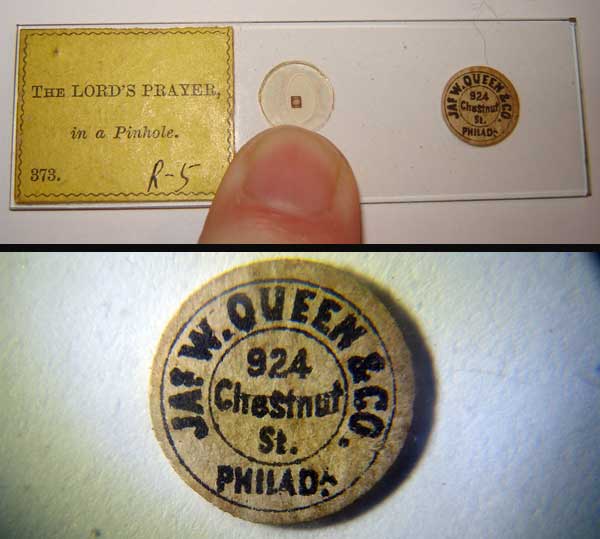
(above photo): If you wanted to own your own microscopical Lord’s Prayer back in the 1800’s you would get one from a scientific instrumentation company. Here is one from the James Queen Company, 924 Chestnut Street, Philadelphia, PA — one of the largest suppliers of scientific apparatus in the 19th century.
Microphotography was invented by John Benjamin Dancer of England in 1839. The first microscopic Lord’s Prayer began as a microphotograph. Utilizing the simplest of equipment, including the use of a single candle for illumination and exposure, onto early light sensitive emulsion, Dancer was able to achieve an astonishing reduction ratio of 160:1.
Many others followed Dancer, by using the Lord’s Prayer as their own example for demonstration and exhibits. As such, it quickly became what is known as a “reference standard”.
Out of all of the many different microphotographs of the mid 1800’s, including those of artwork, travel and famous people, if you wanted to show that you could do something smaller than the previous efforts of others, the Lord’s Prayer is what you would use to do it.
Micro Lord’s Prayer entries were displayed at the largest science and technology exhibitions in the world. And those would include such prestigeous events as the 1851 Great Exhibition in London; the 1915 San Francisco Exposition; the 1933 Chicago World’s Fair Century of Progress; and many more.
Crowds of people would stand in long lines, in Europe and America, just to catch a glimpse of the world’s smallest Lord’s Prayers through the beautiful, brass microscopes of the day.
The Lord’s Prayer, The Apostles Creed, and The Ten Commandments were all famous microphotographs that were so small, they could not be seen by the unaided human eye. They could only be read under microscopes.
While the science and technology behind microphotography may seem very antiquated in comparison to modern methods, it was a very serious science and technology for its time.
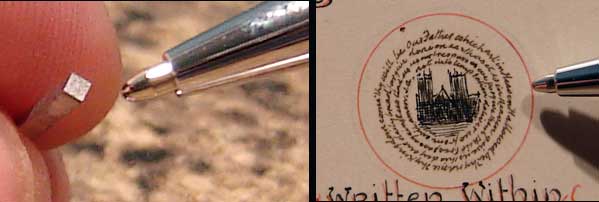
(above photo): American Type Foundry (left) and handwritten example (right) of micro Lords Prayers. The ATF sample (left) has 66 words and 271 characters including punctuation. The letters being only .0026 inches high and .0002 inches in thickness. I’ll have a very special presentation on handwritten Lord’s Prayers (right) in an upcoming installment.
As an example, during the Franco-Prussian war of 1870-71, microphotographs of battle plans and dispatches were regularly flown by carrier pigeons. Back and forth between Paris and the battlefields. Once received, the microfilm would be greatly enlarged and projected onto walls with the use of the famous Magic Lantern projectors.
In World War II, microphotography techniques were used by the United States (with VictoryMail) and England (with Airgraph), to reduce the amount of cargo space that mail would require.
It continued to be the content of choice for well over a century, moving into other methods such as micro engraving, and even typography. It became very popular with handwriting. People would test their skill at writing the smallest Lord’s Prayers that they could write. One of the world’s most famous historical figures that gave it a try, was inventor Thomas Edison.
Today, in the 21st century, we have scripture traveling on laser beams, and being stored with nanotechnologies such as 3-dimensional laser holographic data storage.
Let’s break it down:
- Back in the 1800’s, the microscopic Lord’s Prayer became the reference standard for showing advancements in miniaturization.
- Microphotography eventually led to micro and nano photo lithography.
- Micro and nano photo lithography led to the development of computer chips and circuits.
- Computers (tracing their printed circuitry roots back to microphotography) provided the necessary calculations to put the first man on the surface of the moon in 1969.
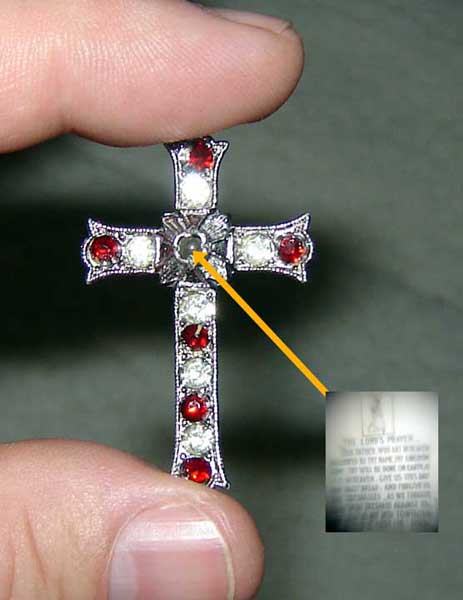
(above photo): A built-in magnifying lens enlarges a micro Lord’s Prayer inside this 19th century jeweled cross. The magnifier is a modified Stanhope lens. Invented by René Dagron in 1857, he received “honorable mention” when displaying them at the 1862 London Exhibition. He presented one to Queen Victoria. They are still popular today in the 21st century.
So the next time you look up at the moon, in God’s great Heaven above, remember hearing about the history of microscopic Lord’s Prayers. And how they helped to have someone walk on the moon … and, some day, beyond.
The author / presenter can be contacted at: fd316@celebratethebible250.com


 America 250 Semiquincentennial Bible Celebration