In this episode of Celebrate the Bible, Francis Douglas conducts a thorough analysis of a 1563 illustration from the Luther Bible that portrays Earth from space. This artwork, which makes reference to Genesis, underscores God’s creation of celestial bodies and suggests a geocentric perspective. Douglas articulates the importance of historical biblical documents.
PODCAST (LISTEN NOW 7 min):
PODCAST TRANSCRIPT:
Today on Celebrate the Bible we’ll take a look at a Bible illustration that shows the Earth from space.
I’m Francis Douglas, and welcome to Celebrate the Bible.
They say that a collection is only as good as the material in it. If so, then a piece such as this would certainly be at the top of anyone’s list.
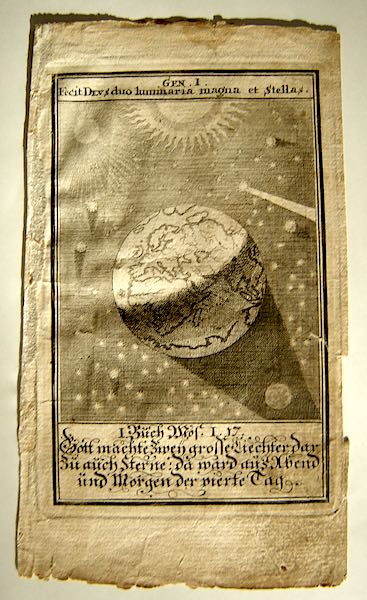
This fascinating illustration is purportedly taken from the 1563 Luther Bible: a massive, illustrated folio, containing both Old and New Testaments. It contains 151 woodcuts from the workshop of Virgil Solis.
I obtained this illustration as a stand-alone image many years ago, and the person that sold it to me passed away shortly thereafter. Therefore, details regarding this image is somewhat limited, but we can still take a look at it, and decipher what we are looking at.
Let’s work from top to bottom, and, if you are listening to this as a podcast, and would like to view the images, please go to my WordPress web page at celebratethebible.com.
If the story is no longer on the first page, just type “earth in space” into the search box, then click on the link that comes up.
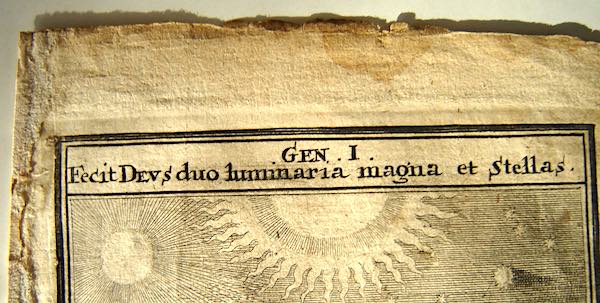
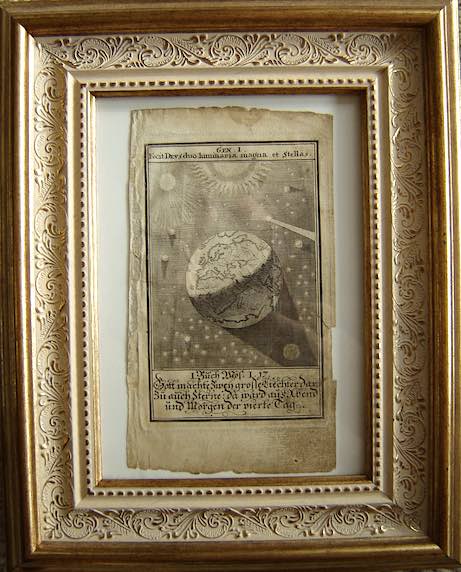
First, we notice at the very top of the illustration, that it references Genesis chapter 1, verse 16 in Latin: Fecit Dev s duo luminaria magna et Stellas, which translates to: He made the two great lights and the stars.
According to Genesis 1:16–18, God created the two great lights on the fourth day: the greater light (representing the sun) to rule the day, and the lesser light (representing the moon) to rule the night. He also created the stars to provide light on the Earth, separate light from darkness, and act as markers for seasons, days, and years.
And here are the verses themselves from verse 16 through verse 18: And God made two great lights; the greater light to rule the day, and the lesser light to rule the night: He made the stars also. And God set them in the firmament of the heaven to give light upon the earth, and to rule over the day and over the night, and to divide the light from the darkness: and God saw that it was good.
Just underneath this line of text we have the illustration itself. Now, I’m not sure if this is a wood cut or an engraving. To me, there seems to be a perimeter of an impression of some sort, and I’m not certain if both wood cuts and engravings show this on the receiving paper.
Leaving that as a mystery for now, let’s just take a look at what the Bible artist is conveying to us:
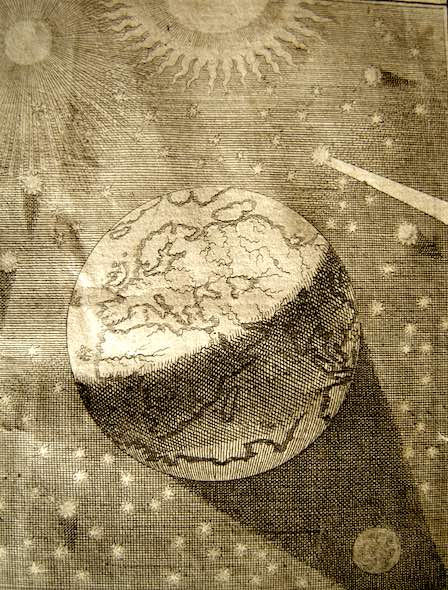
First, we notice the Earth itself, being bathed in the illuminating light of the Sun. Also take note of the shadow that the Earth is creating, placing what appears to be the moon within the shadow.
This shadow is referred to as an umbra today. And the moon in the illustration would be in the totality of an eclipse. How interesting for 1563!
We also see what appears to be a comet traveling toward the sun, along with stars, and small planets casting their own shadows (or umbras).
One the surface of the Earth, we can see land masses and oceans.
And, most importantly, the Earth appears spherical and free-floating in space. Exactly as it turned out to be as seen on our space missions to the moon.
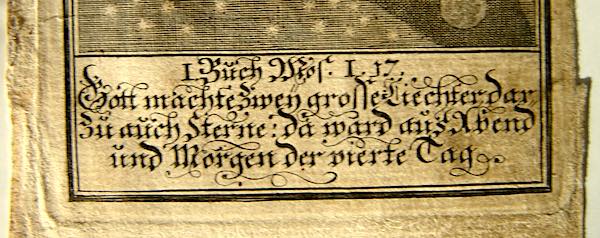
Just below the illustration, at the bottom, we see another reference to Scripture, Genesis chapter 1 verse 17, this time in German, which states: And God set them in the firmament of the heaven to give light upon the Earth.
As a sidenote, I have always been fascinated by the fact that the Heaven and Earth were created on day one, and the sun, moon, and stars were created, and placed, on day four.
This always said to me that the Earth was clearly central to creation.
In other words, the sun would be more likely to travel around the earth, rather than the Earth around the sun.
This viewpoint, known as Geocentrism, places the Earth stationary at the center of all of God’s creation. It wasn’t until the 16th century that opposing view points began to gain traction.
Keeping the above mantra in mind — that a collection is only as good as the material in it — I have many historical prints and documents associated with the Biblical geocentric view of God’s creation. These include pieces from the time of Copernicus, Galileo, Kepler and Tycho Brahe.
But that is for another post in the near future!
For now, I hope that you have enjoyed this presentation.
So, until we meet again, and for celebratethebible.com, this is Francis Douglas.
If you would like me to give a presentation at your church, school, gallery, or organization, please let me know. My contact information is below:
Contact Francis Douglas: fd316@celebratethebible250.com
The topic I cover is the History of the Christian Holy Bible in America.
Your group will not only learn about it. They will also see, on display, pages from the most significant Bibles in American history.
I will be available for Southern New Jersey, Southeastern Pennsylvania, and Northern Delaware.


 America 250 Semiquincentennial Bible Celebration