LISTEN NOW (13 Minutes):
PODCAST TRANSCRIPT:
Someday soon, communication will move through light — using lasers and photonics — and evangelism will move with it.
My name is Francis Douglas*, and I would like to welcome you to Celebrate the Bible.
In the next few minutes, I’d like to share a simple idea: God has always used the “tools of the day” to carry His Word farther than one voice, one room, or one lifetime. Every new medium — every new way light and sound can travel — becomes a new roadway for the Good News.
The story of our Holy Bible stretches back to the earliest days of human communication. It began as spoken word — voice to ear — then traveled by tablets, scrolls, and manuscripts, before surging forward through the printing press. From there it rode each new wave — radio, television, computers, smart phones, and wireless networks. And now, in the 21st century, we are stepping into technologies that transmit and compute with light itself — photonics, and even holographic forms of data storage.
I thought I would begin this presentation by dividing it into two parts. Part one will describe the project in simple, everyday language — without the technical details that can cause listener fatigue: techniques, formulas, and formulations.
Part two will contain the technical information that has been eliminated from part one.
Let’s begin…
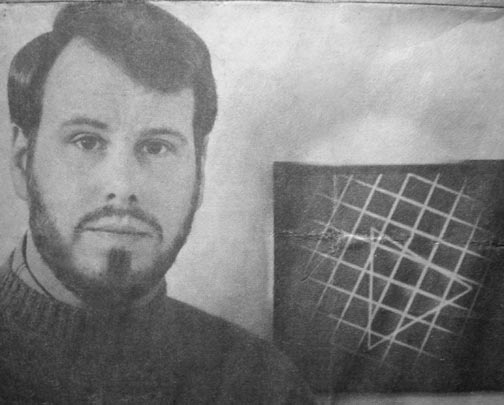
(above photo): The author in the 1980’s is shown next to one of his computer-generated, laser holograms titled: Celestial Navigator.
Many years ago, I didn’t realize that in some places around the world, owning a Christian Bible is restricted — or even illegal. Exactly how many places? That depends on who’s keeping track. But honestly, even if it were only one, that would still be one place too many.
I was fascinated when I started reading about the brave men and women who risk their lives to bring the Gospel of Jesus Christ to people living in those places. I’d read story after story of Bibles being smuggled in the most ordinary-looking ways — tucked inside the rubber tires of Jeeps, hidden in large sacks of flour, and so on.
I had had my own laser studio and lab since 1983. Over the years, I worked with — and taught — holography, the Nobel Prize-winning field that lets us record and reconstruct light in remarkable ways. And as I watched what this technology could do, I started to wonder: could some of these ideas be adapted into a kind of “stealth” method for sending and receiving information? So, I set out to create a few sample pieces — simple demonstrations — to show what that might look like.
The purpose of my project was simple: to help the Christian Holy Bible reach people living in places where owning a Bible is restricted — or even illegal.
To do that, it uses what you might call laser-based “stealth” technology. In other words, it’s designed so that what’s really there is hard to detect — at least until you know exactly how to look for it.
The technology behind it is called holographic data storage — using patterns recorded in light to store information in a way that can look completely ordinary from the outside.
To demonstrate this, I use something very ordinary: a little box of candy.
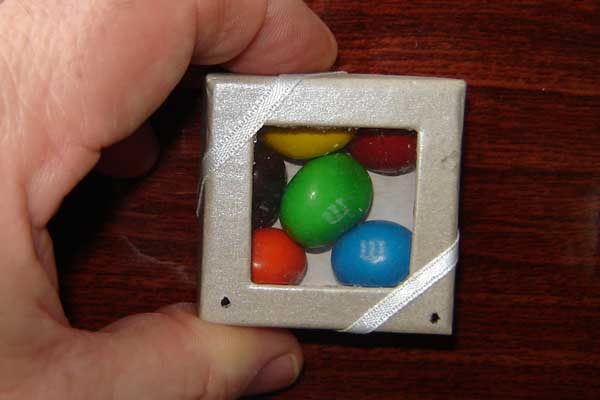
(above photo): This box of candy pieces contains a photopolymer film which has the artistic image of Jesus Christ embeded within the hologram. A laser pointer can project the image.
It has a clear lid, so you can see the bright, colorful pieces inside. To anyone else, it’s just a tiny candy box — nothing about it hints at the laser- and optics-based photonic science it actually contains.
Someone could lift the lid, take a piece of candy, and then — just like anyone would — set the lid right back on top.
But here’s the difference with this box: that clear window in the lid isn’t just plastic.
Embedded in it is an image that’s essentially invisible in normal use — an image of Jesus Christ. I chose this image because it’s one of the most widely recognized depictions of Jesus in the world: Head of Christ, by artist Warner Sallman. I happen to own a 35-mm museum slide of that artwork, so it was convenient to use as my source image in the holography setup.
In ordinary handling, you can’t see the image — and there’s no hint that an image is there at all, from any viewpoint or angle.
In fact, it doesn’t contain a picture at all. What it contains is an interference pattern —created by the laser light used to record it. I’ll come back to that in just a few minutes.
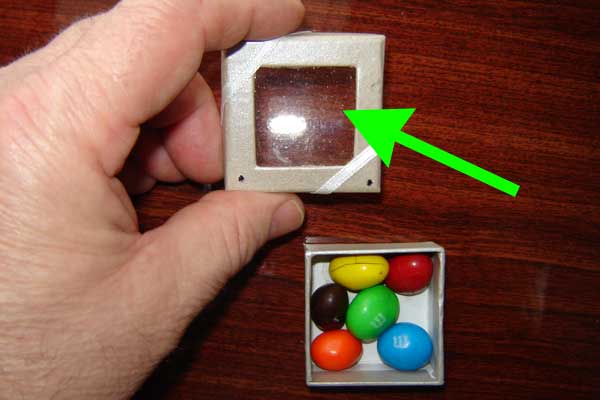
(above photo): The clear film is actually a light-sensitive emulsion. This is exposed in a laser laboratory. It looks like any other clear lid to a box of candy. Below you will see what happens with a laser pointer. (white spot is from camera flash).
You only see it when you hold the lid at just the right angle and shine a laser through the film. Then the image of Christ appears on a wall, the ceiling, or whatever surface you aim it at.
Any simple, inexpensive laser pointer will work.
Now, keep in mind that this encoded film can also contain text. Therefore, scripture can, and has been, used as well. Another piece that I did was of the Lord’s Prayer.
No one would ever know that this was anything more than a little box of candy pieces. And, unless you know the specific way that the film is to be held, no one will ever see the images or text — even if they used a laser pointer.
Keep in mind that a candy box is just one example of how this can be used. There are many, many additional applications.
If you find this interesting and are listening to the podcast, and if you would like to see photos of the candy box, and the resulting projected image, just go to celebratethebible250.com.
Let’s move on to part two:
Now for the technical information. As mentioned earlier, this technology is termed: holographic data storage. In this instance, I am utilizing analog imaging, rather than storing and retrieving digital information. The film is referred to as a holographic optical element, and this technology is used in many modern industrial applications today, such as heads up displays for automobiles and aircraft.
The film that allows people to look through the top of the candy box and see the candy inside is a piece of light sensitive photopolymer film. The resolution is quite high: in some cases, with a resolving power of 10,000 lines per mm. Let me repeat that: 10,000 lines PER MILLIMETER.
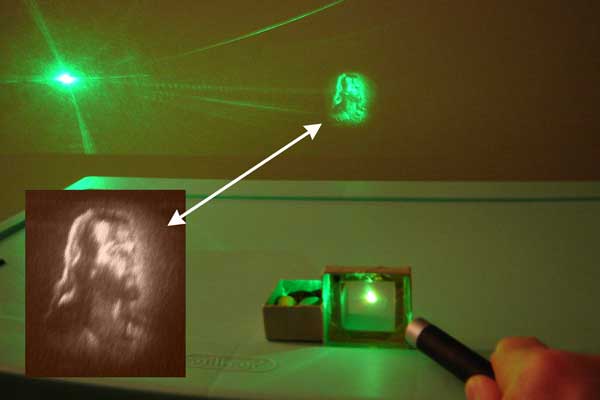
(above photo): And here we have the end result. An artistic image of Jesus Christ is stored as a holographic image on. the candy box lid. A simple laser pointer projects the image. Projected image in green, close up image in lower left corner.
With resolution that high, of course, vibrational tolerances are rather tight. If any piece of equipment moves a fraction of a wavelength of light during the exposure, the recording is ruined. Therefore, work must be done on vibration isolation systems, in a controlled environment.
During the exposure, the photopolymer molecules cross-link and “lock in” a pattern created by the laser light. Because laser light is coherent, the two light waves in the setup form a stable interference pattern in the emulsion. Where the waves meet crest-to-crest, they reinforce each other (resulting in a stronger signal), and that gets recorded at that point. Where a crest meets a trough, they cancel each other (resulting in a weaker signal), and that gets recorded too. In this way, the film records a full map of light-and-dark variations throughout the volume of the recording material.
One of the more interesting aspects of this method is the ability to include storage of the magnification optics. Since a hologram is capable of storing 3-dimensional information, this piece of exposed photopolymer also contains the optical path used to make it. Since the optics themselves within that path are recorded, they function exactly as they would as if they were physically there again.
Several years ago, I had a chance to demonstrate this at a meeting of the New York Microscopical Society: showing how the optics of a microscope can be recorded within a holographic image and then reconstructed — in light — to function as if the optics were there in front of you again.
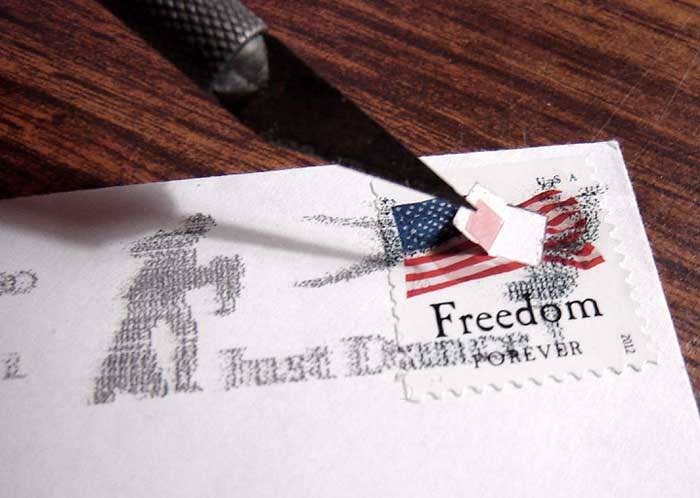
(above photo): Another method shows how a holographic rendition of the Holy Bible can be hidden under a postage stamp. This tiny piece of photopolymer film contains a laser recording of the entire Bible.
A second interesting aspect is that the image is not localized anywhere on the film surface. This means that any “spot” that the point of the laser passes through, can reconstruct the entire, complete image. This includes the ability to cut any size piece of film away from the main piece, and it will still reconstruct an entire image. Cut a second piece of film away, and it will reconstruct a second, entire image. A third piece? a third entire image! And so on and so forth.
Yet … if you put all of the pieces of film back together again, and they all come together to form a single, entire image once again.
Please believe me that this bizarre aspect of analog holographic data storage is true. However, it’s only bizarre to those outside of the field of lasers and holography. To those who work, or at one time have worked, within the fields, it’s just another day.
As for reconstruction of Biblical scripture or imagery, a geometrical determination must be made initially during the set-up of the optical system. This geometry must be used to reconstruct the resulting image. Even I have a hard time remembering the exact orientation of the box lid. So, I have resorted to have to put a little mark to remind myself how to hold it.
Even then, the image will not reconstruct unless the angle of the incoming laser pointer beam is correct.
It works beautifully providing someone has a laser pointer and knows the geometric combination.
It would be able to take Bible verses into areas of the world where it is very dangerous to have the Bible. And, believe me, once you see how stealth this technology is, no one will ever be the wiser.
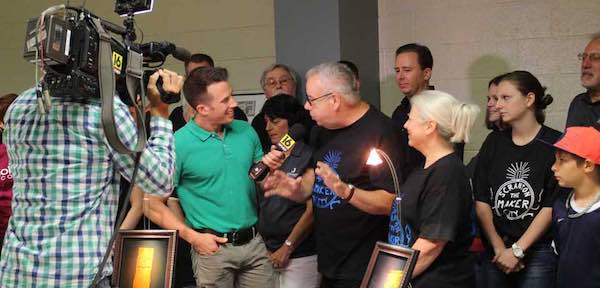
(above photo): The author and his wife Debi giving a demonstration to a local television station about lasers and holography.
So, in closing, where does this go from here?
Now, I’m not saying that in the future people will be walking around with hologram-covered candy boxes and laser pointers. Not at all. I’m simply using this familiar little box of candy to make the point that we won’t stay where we are. Technology will keep moving forward — and with it, we’ll discover new and exciting ways to share the Gospel of Jesus Christ. And many of those future tools will make it easier to bring the Gospel into places where, in the past — and even today — it hasn’t been easy to go.
I hope you enjoyed this brief online presentation. If your group or school would like a presentation, I have a small demonstration that I can bring. I have been providing presentations for over 40 years.
I can travel to the Philly or New York areas, as I’m close to both the Atlantic City Expressway, and also the Garden State Parkway, with easy access to east/west and north/sound travel.
Also, before I close, please keep in mind that this is just one of many applications of laser and photonic communication technologies that will one day help spread the Good News of our Lord and Savior Jesus Christ.
CONTACT: fd316@celebratethebible250.com
* My name is Frank DeFreitas, but I post under the easier-to-remember name of Francis Douglas (my first and middle name).

 America 250 Semiquincentennial Bible Celebration