Today’s episode of Celebrate the Bible explores the Stanhope viewer, an innovative invention from the nineteenth century that allowed microphotography to be accessible without a microscope. Created by René Dagron, these tiny optical wonders showcased the Lord’s Prayer and transformed photography into a personal experience, combining art and science in everyday life.
PODCAST LISTEN NOW (7 minutes):
PODCAST TRANSCRIPT:
Today on Celebrate the Bible, we reflect on one of the most remarkable inventions of the nineteenth century: the Stanhope viewer.
I’m Francis Douglas.
Because of what they contain, the Stanhopes that you see here are among the most beloved examples ever produced. Within them is preserved a text cherished throughout the Christian world: the Lord’s Prayer.
To appreciate their quiet beauty, we must step back into an age of invention, photography, and miniature wonder.
Let’s Begin:
In the middle of the nineteenth century, a remarkable optical curiosity appeared — modest in size, yet capable of revealing a hidden world.
At the heart of this story is the Stanhope lens, a simple magnifying lens associated with Charles Stanhope, the third Earl of Stanhope — a British statesman, inventor, and man of science, born in 1753.
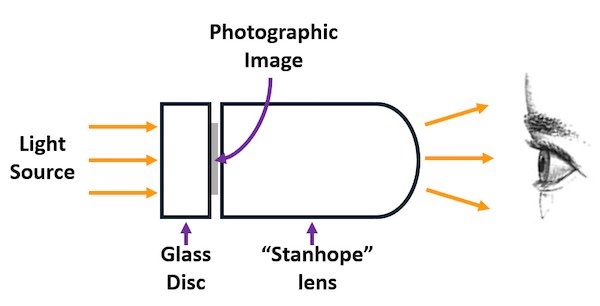
Photo (above): How the Stanhope system works: René Dagron modified the lens as shown here in this illustration from https://microscopist.net/Dagron.html
Though he died in 1816, the lens that bore his name would later help inspire one of photography’s most ingenious and enduring forms.
If you are listening to this as a podcast and would like to see the photographs featured in this episode, you can find them on my WordPress page at celebratethebible250.com.
In 1851, British scientific instrument maker John Benjamin Dancer achieved a breakthrough.
Using the newly developed collodion process and a microscope adapted as a camera, he produced microphotographs measuring only a few square millimeters.
Entire scenes, texts, and portraits could now be reduced to a scale invisible to the unaided eye. But there was a problem: to see them, a viewer still needed a microscope — expensive, specialized, and far beyond everyday reach.
Then came the decisive advance.
Six years later, René Dagron found a way to bring these miniature images to the wider public. His solution was radical and simple at once: remove the microscope from the experience entirely.
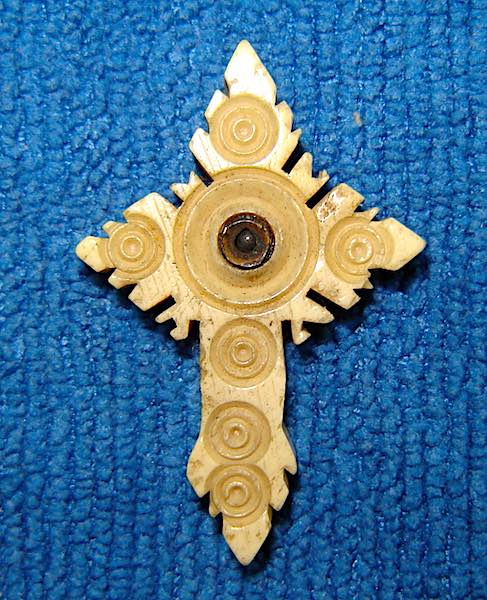
Photo (above): This original Stanhope viewer, possibly made of bone, is from the 1800’s and shows a picture of Jesus with children. The micro photo states that it is for First Holy Communion. Collection of the author.
Dagron transformed that lens into something truly extraordinary. By joining it to the art of microscopic photography, he made it possible to behold tiny images without the aid of a microscope.
The method was as elegant as it was ingenious.
He adapted a small lens based on the Stanhope design, then mounted a microphotograph onto its flat end at a precise focal point, securing it with Canadian balsam adhesive.
Many of those original pieces still survive today!
In doing so, he removed the need for costly scientific instruments and placed microphotography, quite literally, into the palm of the hand. He called these creations microscopic photo-jewelry — small objects in which science, craftsmanship, and wonder were joined together.
The result was remarkable. For the first time, a hidden image could be viewed directly, simply by lifting the lens to the eye. No microscope was required. No elaborate apparatus stood in the way.
Only a quiet moment of revelation.
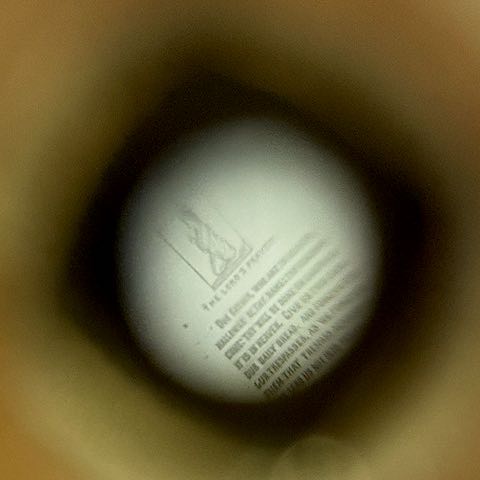
Photo (above): Looking through one of the Stanhope viewers showing the micro Lord’s Prayers. It also depicts a child on their knees saying their prayers. Collection of the author.
With that innovation, microphotography passed beyond the laboratory and entered daily life. What had once belonged to specialists could now be carried as jewelry, kept as a souvenir, or treasured as a small and personal wonder.
The public first encountered Dagron’s viewers at the International Fair in Paris in 1859, and the response was immediate.
For those who first looked through it, the experience must have seemed almost wondrous: a simple object, held to the eye, revealing an entire hidden image within.
Demand rose quickly. By June of that year, Dagron had opened a factory devoted exclusively to their production. These miniature viewers were set into jewelry, souvenirs, and keepsakes — decorative objects that also carried an element of surprise.
When he exhibited them again in Paris that August, their success was unmistakable. Dagron’s invention had become more than a novelty. It had become an object of widespread admiration.
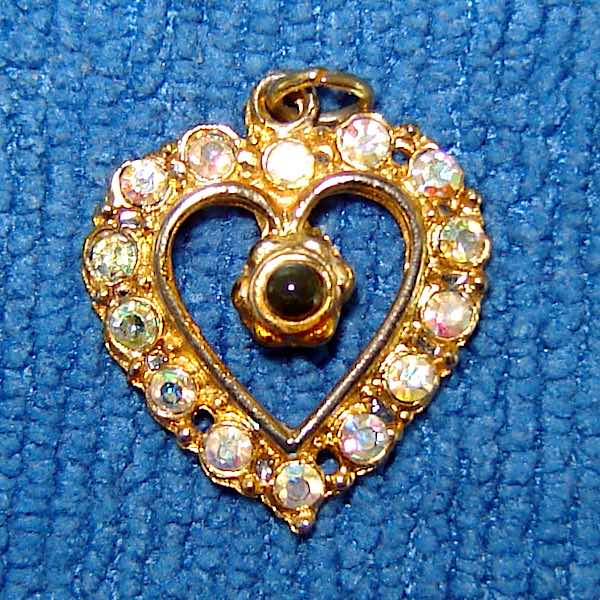
Photo (above): This original Stanhope viewer, used as a charm bracelet, or for a necklace, is from the 1800’s and shows the Lord’s Prayer. Collection of the author.
In 1860, he patented the invention under the name Bijoux Photomicroscopiques — microscopic photographic jewels. He also embraced mail-order marketing, allowing these marvels to travel far beyond Paris, and into an international market.
By 1862, Dagron employed one hundred and fifty workers and was producing as many as twelve thousand pieces a day.
What began as a technical innovation had become a worldwide phenomenon — a meeting of optics, photography, and human wonder.
Although the last true Stanhope was produced in 1972, the wonder it inspired has never entirely faded. Even now, these tiny viewers stand as a testament to an age when invention, patience, and imagination could join together to make the smallest image feel almost sacred.
And that is the story of the Stanhope viewers.
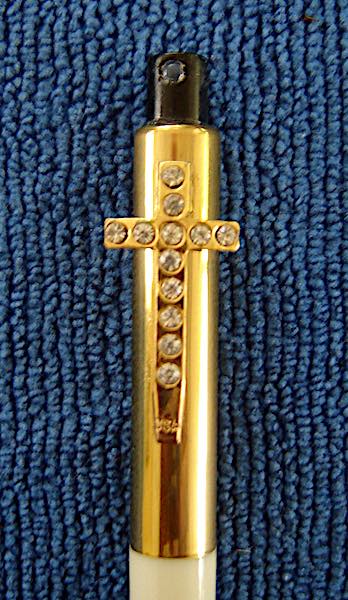
Photo (above): This original Stanhope viewer is a pen, with the lens in the top black clicker. It shows the Lord’s Prayer. Date unknown. Collection of the author.
So, until we meet again, and for celebratethebible250.com, this is Francis Douglas.
If you are interested in having me present at your church, school, gallery, or organization , my contact information is below.
My email address is fd316@celebratethebible250.com
For the America 250 celebration year, my presentation is: The History of the Christian Holy Bible in America.
Not only will your group learn about it, but they will also view an exhibit of pages from some of the most important Bibles in American history.
I am available for Southern New Jersey, Southeastern Pennsylvania, and Northern Delaware.
RESOURCE: For more information on Antique Stanhopes, here is a great resource: https://microscopist.net/Dagron.html

 America 250 Semiquincentennial Bible Celebration